

Stop Asking 'Vs.' and Start Shipping 'With'
Stop wasting time on styling boilerplate. Every component you build from scratch delays your ship date. In 2025, modern React development is defined by efficiency, accessibility, and speed. You've heard the buzz: shadcn/ui is everywhere, and Tailwind CSS is the undisputed king of utility styling. But the core question—which one do I choose?—is fundamentally flawed.
This guide cuts through the noise. We'll show you why the shadcn vs tailwind debate is a false choice, how to leverage their synergy for unmatched productivity, and the exact architectural model that top developers use to build faster, cleaner UIs today. You don't have to choose a path; you just have to optimize your stack.
Quick Takeaways:
- Tailwind CSS is the Foundation: It is the utility framework that provides the styling language.
- shadcn/ui is the Accelerator: It’s a CLI that installs pre-built, accessible components styled with Tailwind.
- It's Synergy, Not Competition: The modern stack is Next.js + Tailwind + shadcn/ui.
- Code Ownership is Key: shadcn components are copied directly into your repo, giving you full control and zero lock-in.
- Ship an MVP in Hours: Use shadcn to skip straight to production-ready UI primitives, saving days of development time.
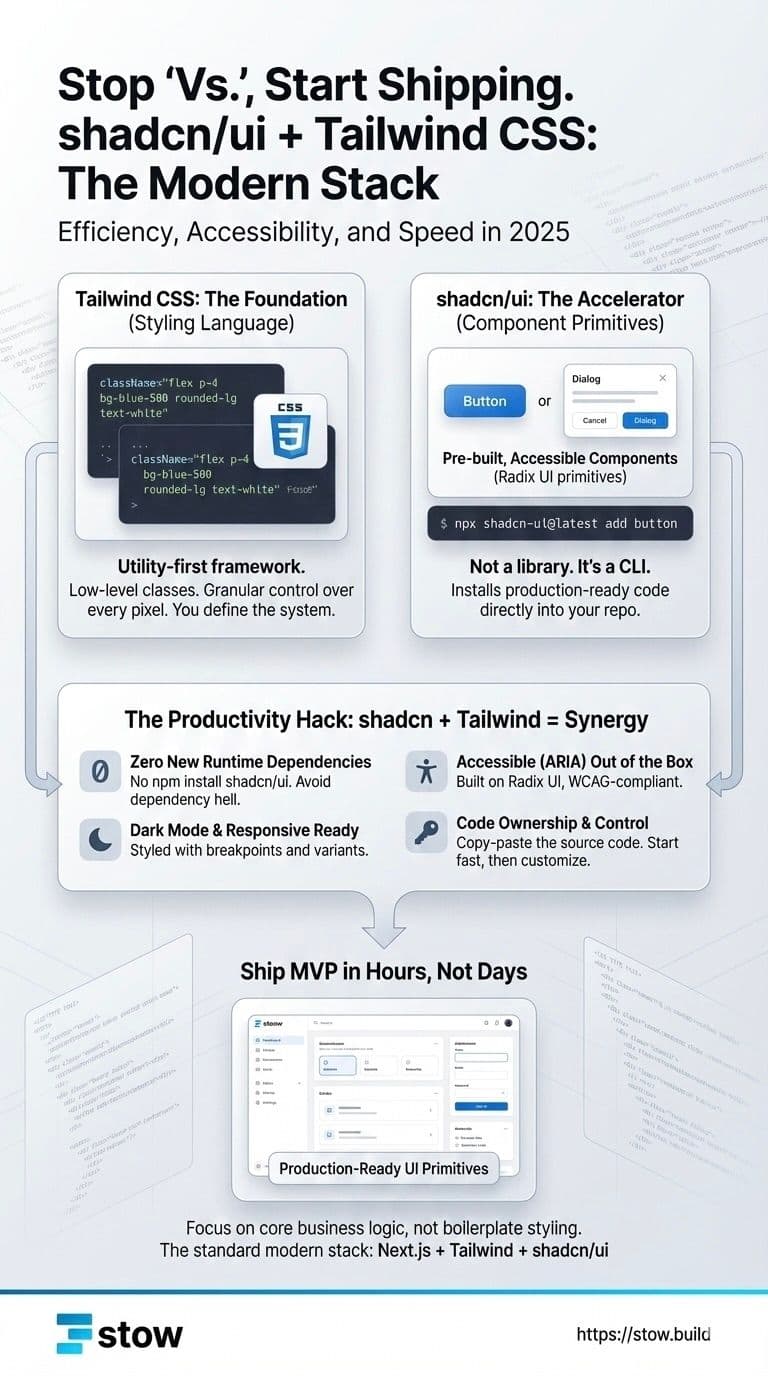
Tailwind CSS: The Utility Foundation
Tailwind CSS is not a UI kit. It is a utility-first CSS framework. It provides thousands of low-level classes—like flex, p-4, and bg-blue-500—that let you style elements directly in your markup. This grammar is what makes building UIs efficient.
Build from the ground up. When you use pure Tailwind, you are designing the entire system. You define your configuration, color palette, and utility scale in tailwind.config.js. You get ultimate, granular control over every pixel.
Control and Versatility. Tailwind is the right choice for bespoke designs or large-scale systems where no pre-built components can match the design specification. It’s light, fast, and infinitely scalable. You are the architect.
shadcn/ui: The Component Layer
shadcn/ui is not a competing framework. It is a curated collection of production-ready, accessible components built using Tailwind CSS and Radix UI primitives. It takes the power of the Tailwind utilities and wraps them into pre-assembled UI blocks.
The CLI is the Product. You don't npm install shadcn/ui. Instead, you use a simple CLI to pull components like a Button, Dialog, or Dropdown Menu directly into your repo.
npx shadcn−ui@latest add button
This command copies the React component file, complete with all necessary Tailwind classes, into your project's /components folder. It’s an instant productivity boost.
The Core Difference: Utilities vs. Components
The key distinction is function: Tailwind provides the styling language, and shadcn provides the pre-written, ready-to-deploy sentences.
| Aspect | Tailwind CSS (The Language) | shadcn/ui (The Component) |
|---|---|---|
| Core Focus | Atomic utility classes for styling. | Pre-built, accessible components. |
| Output | Raw CSS utilities for custom styling. | Component files (.jsx/.tsx) pre-styled with Tailwind classes. |
| Installation | npm package. Configured via tailwind.config.js. | CLI tool. Copies source code into your repo. |
| Best For | Bespoke designs, pure control, custom libraries. | Rapid prototyping, MVPs, accessible defaults. |
Customization and Control
With both tools, you maintain complete control.
- Tailwind: Customization is infinite. You define the rules of the design system in your config file.
- shadcn/ui: Customization is direct. Because you own the component source code, you can modify the Tailwind classes, change the component's logic, or even rewrite parts of it without waiting for an upstream package update.
Installation and Dependencies
This is where shadcn fundamentally changes the game.
Tailwind requires an npm install and a configuration setup. Standard stuff.
shadcn/ui adds zero new runtime dependencies to your project. By copying the code, you avoid dependency hell and versioning issues. Your build stays lean, and your components stay yours. This developer experience is why the stack has exploded.
Why Developers Stack shadcn/ui and Tailwind
For most developers and teams in 2025, the debate is over. The standard modern stack is Tailwind + shadcn. Here's why you should build this way:
The Productivity Hack
shadcn handles the painful parts of UI development:
- Accessibility (ARIA): Components are built on Radix UI, ensuring they are WCAG-compliant out of the box. No more struggling with tab indexing or ARIA attributes.
- Dark Mode and Responsiveness: Components are already styled with responsive breakpoints and dark mode variants.
- Boilerplate Elimination: Instantly skip the five hours of building a well-formed, interactive
TooltiporModal. You get production-ready code in seconds.
Ship faster. It's that simple. Solo devs and small teams use this stack to move with the speed of a large company.
The Ownership Model
The component ownership model is the architectural win. When you copy the code, the component becomes part of your design system.
"Start fast, then customize."
You have the freedom to drastically change the component to match your specific brand without worrying about breaking updates from an external library. This flexibility for scaling and maintenance is unmatched.
When to Choose Pure Tailwind (And Skip the Component Layer)
While the synergy is powerful, there are valid reasons to stick with just pure Tailwind:
- Extreme Minimalism: If your project is a simple marketing site or a landing page that requires only basic elements and no complex, interactive components, shadcn may add unnecessary cruft.
- Truly Bespoke Design: If your designer delivers a UI that is wildly different from the shadcn aesthetic and requires full control over the structural markup, building from scratch with Tailwind is often cleaner.
- Non-React Projects: If you are using another framework where shadcn is not an option, Tailwind remains the universal styling grammar.
Summary: Find it. Stow it. Ship it.
The shadcn vs tailwind debate is a distraction. Tailwind CSS is the powerful engine. shadcn/ui is the turbocharger. Use Tailwind for the base configuration and styling language. Use shadcn for the pre-vetted, production-ready components that save you days of work.
Stop building the same buttons, modals, and dropdowns over and over. Your time is better spent on core business logic.
Ready to level up your architecture and ship faster than ever?
Ready to ship production-ready code today? Browse Stow Components to accelerate your development stack.