

Stop wrestling with boilerplate. Choosing the right foundation for your React UI is the critical path to shipping fast. This guide cuts through the noise to give you the exact architecture you need, balancing speed, customization, and long-term ownership.
TL;DR
- Choose shadcn/ui for rapid prototyping, instant style, and full code ownership. It's the speed-and-consistency champion for solo devs and startups.
- Choose Radix UI for building a bespoke design system from scratch. It is the purist's choice for unstyled, highly accessible primitives.
- shadcn/ui is not a library. It's a collection of pre-styled components (built on Radix) you copy directly into your repo.
- Radix UI is headless. It handles functionality (like keyboard navigation) and accessibility, leaving all styling to you.
- The modern stack: shadcn/ui + Tailwind CSS is the fastest way to a polished, professional UI today.
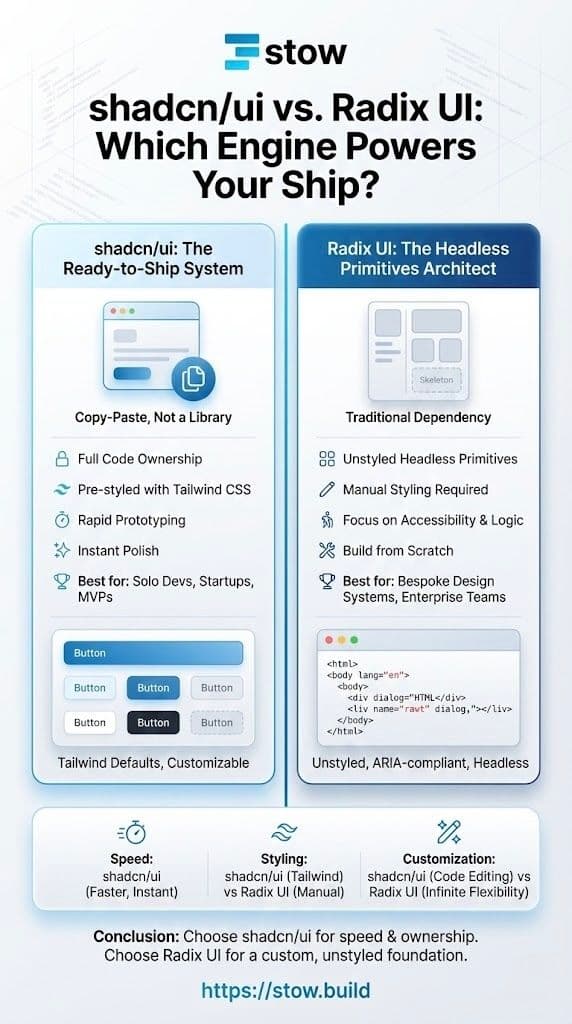
The Core Difference: Library vs. CLI
Before you npm install, you need to understand the fundamental split. Both tools help you build React UIs, but their approach to your codebase is entirely different.
Radix UI is a traditional dependency. It’s an accessible, battle-tested library of headless primitives. Headless means unstyled—it provides the function (the behavior of a button or a menu) but zero visual opinion. You install it, you import it, and you style it manually with your CSS of choice.
shadcn/ui is a unique philosophy. It is not a dependency. You use a CLI tool to copy the component source code directly into your project's /components folder. These components are mostly built on top of Radix primitives and styled with Tailwind CSS.
Radix UI: The Headless Primitives Architect
Radix is where true accessibility and composability start.
It delivers low-level building blocks—think Dialog, Dropdown Menu, or Button. Radix handles the complex stuff: ARIA compliance, keyboard navigation, and state management. The output is raw HTML that is unstyled by design.
- Focus: Functionality, behavior, and accessibility.
- Styling: Manual. Use your own custom CSS, CSS-in-JS, or utility classes.
- Best For: Enterprise teams and large projects where custom styling and rigid design system enforcement are non-negotiable.
If you’re building your own internal component library from the ground up, Radix is the foundation.
shadcn/ui: The Ready-to-Ship Component System
shadcn/ui gives you the Radix functionality with instant polish.
These components look great out of the box, offering a modern, minimalist design aesthetic. The secret sauce is the "copy-paste" model. By owning the source code, you eliminate a massive problem: vendor lock-in.
- Focus: Speed, consistency, and full customization.
- Styling: Tailwind CSS defaults. Instantly polished with variants, focus states, and animations.
- Installation: Use
npx shadcn-ui@latest add buttonto copy the source code. - Best For: Solo developers, startups, and small teams that prioritize fast shipping without sacrificing component quality.
The key is ownership. You start with a great default and can then tweak, evolve, or even rewrite the component over time without fighting a heavy library's internal theming system.
Key Comparison: Speed, Style, and Ownership
| Aspect | Radix UI | shadcn/ui |
|---|---|---|
| Core Focus | Headless accessibility primitives. | Pre-styled, composable components. |
| Styling | Unstyled. Requires manual implementation. | Tailwind-based defaults. Instant polish. |
| Customization | Infinite flexibility (building blocks). | High—edit the copied source code directly. |
| Installation | npm install. Traditional dependency. | CLI-based add. No runtime dependency. |
| Best For | Bespoke Design Systems, Enterprise Apps. | Rapid Prototyping, MVPs, Indie Hackers. |
Why Developers Choose shadcn/ui
In the modern React ecosystem, shadcn/ui has become the dominant choice, recently overtaking giants like Material-UI in popularity. The consensus among developers is clear: it’s the ultimate balance of speed and power.
1. Full Code Ownership. No Lock-In.
This is the killer feature. When you copy the code, you are the maintainer. You avoid dependency bloat, version conflicts, and the risk of a core library deprecating a feature you rely on. As your app scales, you simply refine the components you already own.
"Code you own. Code you can improve, rewrite or replace."
2. Ship Faster Than You Can Type
shadcn/ui components are drop-in and look professional. They save hours of styling boilerplate. For MVPs and side projects, this is non-negotiable. Developers consistently report that the learning curve is gentler, letting them focus on application logic, not CSS implementation details.
3. Alignment with the Modern Stack
It's a perfect fit for Next.js and Tailwind CSS. The utility-first approach of Tailwind makes minor, high-impact changes trivial. You get consistency across your UI without the heavy overhead of a traditional theming system. It's minimal dependencies, maximum impact.
4. Community Momentum
The ecosystem is exploding, backed by Vercel and the broader development community. This momentum means better tooling, active maintenance, and clear pathways for future-proofing your stack (e.g., easy migrations via CLI).
When Radix UI Still Wins
While shadcn/ui is the daily driver for most projects, Radix UI maintains its edge in a few specific scenarios where its pure, unstyled nature is a feature, not a drawback.
Ultimate Flexibility
If you have a large design team and need to enforce a truly bespoke visual language that doesn't rely on Tailwind CSS, Radix provides the ideal blank canvas. It's a structural primitive; the style is 100% up to your CSS pipeline.
Non-Tailwind Stacks
Building with Vanilla CSS, Stitches, or a non-Tailwind CSS-in-JS solution? Radix is the lightweight way to get accessibility features without being locked into the Tailwind class structure.
Team-Scale Control
Large engineering teams often prefer the separation of concerns that Radix enforces. Functionality and accessibility are handled by the primitive, while styling is mandated by internal CSS libraries, guaranteeing design consistency across hundreds of views.
Conclusion
For the vast majority of developers and projects in 2025, shadcn/ui is the superior choice. It combines the rock-solid accessibility foundation of Radix with the rapid, flexible styling of Tailwind. It allows you to start fast, own your code, and evolve your component system without being locked into a vendor.
Choose Radix only if you are architecting a massive, bespoke design system from scratch. For everyone else: stop wasting time.